TYNESIDE POETS!

TYNESIDE POETS!

Sunday, 18 January 2015

BRIDGE HOTEL, NEWCASTLE


WILLIAM BLAKE IN THE BRIDGE HOTEL


A few pints of Deuchars and my spirit is soaring.
The child dances out of me,
goes running down to the Tyne,
while the little man in me wrestles with a lass
and William Blake beams all his innocence in my glass.
And the old experience sweats from a castle’s bricks
as another local prophet takes a jump off the bridge.

It’s the spirit of Pat Foley and the ancient brigade
on the loose down the Quayside stairs
in a futile search,
just a step in the past,
for one last revolutionary song.

All the jars we have supped
in the hope of a change;
all the flirting and courting and chancing downstream;
all the words in the air and the luck pissed away.
It seems we oldies are running back
screaming to the Bewick days,
when a man could down a politicised quip
and craft a civilised chat
before he fed the birds
in the Churchyard.

The cultural ships are fair steaming in
but it’s all stripped of meaning -
the Councillors wade
in the shallow end.

O Blake! buy me a pint in the Bridge again,
let it shiver with sunlight
through all the stained windows,
make my wit sparkle
and my knees buckle.

Set me free of this stifling age
when the bland are back in charge.
Let us grow our golden hair wild once more
and roar like Tygers
down Dog Leap Stairs.


KEITH ARMSTRONG    

Wednesday, 7 January 2015

Saturday, 13 December 2014

THE ENERGY BILL SONG!


THE ENERGY BILL SONG

They’ve got you on the run to run your juice,

They’ve got you on the run to run your juice.

Oh me oh my which one to choose,

You’ll be picking up the tab no matter whose.


You’ve gotta have a stash to burn your gas,

You’ve gotta have a stash to burn your gas.

Oh me oh my they cannot lose,

You’ll be picking up the tab but you don’t know 

whose.


What’s coming through the wires is all the same,

What’s coming through the pipes is all the same.

For everybody knows they’re coming the game,

For everybody knows they’re coming the game.


G. F. Phillips

Tuesday, 9 December 2014

FOR CUNY- JOHN CUNNINGHAM PASTORAL POET 1729-1773


‘Search where Ambition rag'd, with rigour steel'd;
Where Slaughter, like the rapid lightning, ran;
And say, while mem'ry weeps the blood-stain'd field,
Where lies the chief, and where the common man?’
(John Cunningham)
‘Unto thy dust, sweet Bard! adieu!
Thy hallow'd shrine I slowly leave;
Yet oft, at eve, shall Mem'ry view
The sun-beam ling'ring on thy grave.’
(David Carey)

This week an elegant tombstone, executed by Mr. Drummond of this town, was set up in St. John's church-yard to the memory of the late ingenious Mr. John Cunningham. The following is the inscription thereon:
‘Here lie the Remains of JOHN CUNNINGHAM.
Of his Excellence as a Pastoral Poet,
His Works will remain a Monument
For Ages
After this temporary Tribute of Esteem
Is in Dust forgotten.
He died in Newcastle, Sept 18, 1773,
Aged 44.’

The ritual slaughter
of traffic,
hurling itself
against the furious economy,
the commerce of suffering,
the pain of money,
nudges your bones
in this graveyard of hollow words.
I hear you liked a jar
well, here’s me
sprinkling
your precious monument
with a little local wine,
lubricating the flowers
that burst from your pastoral verses.
You toured the boards like me,
torn like me,
with your heart,
terrific heart,
pouring real blood on your travelling sleeve.
Oh, my God!
your lips trembled
with a delicate love
for the fleeting joy,
the melancholic haze,
the love in a mist,
that Tom Bewick sketched in you
amd Mrs Slack fed
as you passed along
this way and that
despair in your eyes.
The fact was
you were not born
for the rat race
of letters,
the ducking and fawning
for tasteless prizes,
the empty bloated rivalry,
the thrust of their bearded egos.
You wanted wonder,
the precise touch
of the sun on your grave,
the delicious kiss
that never comes back.
I’m with you, ‘Cuny’
in this Newcastle Company of Comedians;
I’m in your clouds of drunken ways;
I twitch with you
in my poetic nervousness
along Westgate Road.
And the girls left their petals for you
like I hope they do for me
in the light of the silver moon,
thinking of your pen
scratching stars into the dark sky.


KEITH ARMSTRONG

Sunday, 16 November 2014

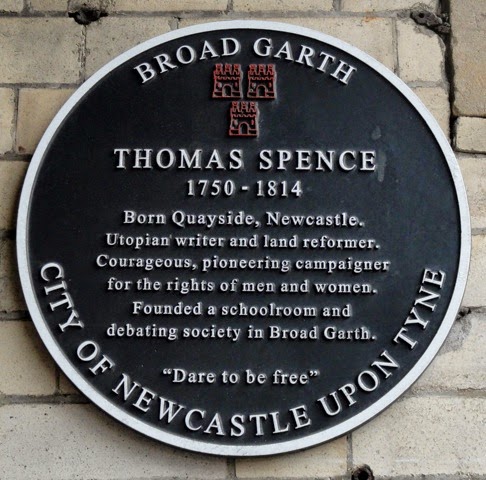
THOMAS SPENCE 1750-1814


NEWCASTLE UNIVERSITY RELEASE – 10 NOVEMBER 2014
Radical idea unearthed in Newcastle
 
A revolutionary document that lay undiscovered in a Newcastle library for over 200 years has just been published.
 
Thomas Spence’s penny pamphlet Property and Land in Every One’s Right is one of the founding texts of the English radical tradition, pre-dating Marxism.
 
Believed lost for many years, the original has not been in print since 8 November 1775.
 
This year marks the 200th anniversary of the death of its author - an important and original voice in political history.
 
“Spence’s story is a rags to rags tale of defiance and ingenuity,” explains Prof Bonnett, of Newcastle University. “Today his name is little known but this in no way reflects his significance. ’Spenceanism', which called for the democratic, common ownership of the land, was once hugely influential among the poor,” he adds. “It also appears to be the only political ideology to have ever been outlawed by the British Parliament.”
 
Thomas Spence: The Poor Man’s Revolutionary is edited by Prof Bonnett and local poet Keith Armstrong, and includes expert opinions from all over the world about the wide-ranging impact of this unique, working-class polymath.
To reach a mass, semi-literate audience, Spence invented his own phonetic alphabet and spread his message in unique ways, issuing thousands of coins embossed with political messages.
 
“Perhaps Spence can be best summed up by one of the inscriptions he placed on one of his self-minted coins, the coin his friends chose to place in his coffin,” says Prof Bonnett. “It depicts a cat, staring straight out at us, and around it are the words, ‘IN SOCIETY LIVE FREE LIKE ME’.
 
“He was very stubborn and not at all interested in compromise, or reforms and half-freedoms.”
 
Born into poverty on Newcastle Quayside in 1750, Spence is seen as the father of children's rights. He also accorded women equal democratic rights and is believed to be the first person to write about 'the rights of man' in English.
 
In 1787 he moved to London, setting up a bookshop on Chancery Lane, and became immersed in the capital’s turbulent radical sub-culture. He went to prison for selling Thomas Paine’s The Rights of Man, but disagreed with him on a number of fundamental issues so began issuing his own inflammatory penny weekly, Pigs’ Meat or, Lessons for the Swinish Multitude. “Spence took considerable risks in a dangerous city: spies, threats and conspiracy swirled around him,” says Prof Bonnett. “His wish for ‘perfect freedom’ often took him one step further than his peers.”
 
Prof Bonnett will be discussing Thomas Spence: The Poor Man’s Revolutionary, with Dr Keith Armstrong at the North East Labour History Society Open Meeting at 7pm on 18 November 2014 at the Lit & Phil, Westgate Road, Newcastle http://www.litandphil.org.uk/index.shtml
 
Ends
10/11/14
 
Notes to Newsdesks:
 
(i) Dr David Garner-Medwin, who died in June 2014, was leafing through some battered 18th century documents at the Literary and Philosophical Society when he came across an intriguing penny pamphlet titled ‘Property and Land in Every One’s Right, dated 8 November 1775. He immediately recognised it as one of Thomas Spence’s founding texts of the English radical tradition.
 
(ii) Three years after Spence’s death an Act of Parliament was passed prohibiting ‘All societies or clubs calling themselves Spencean or Spencean Philanthropists’.
 
(iii) Prof Bonnett will be discussing Thomas Spence: The Poor Man’s Revolutionary, with joint editor Dr Keith Armstrong, at the North East Labour History Society Open Meeting at 7pm on 18 November 2014 at the Lit & Phil, Newcastle.
 
(iv) Book details: Thomas Spence: The Poor Man’s Revoluntionary pub Breviary Stuff Publications £15.00 214pp paperback ISBN 978-0-9570005-9-9 http://www.breviarystuff.org.uk/thomas-spence-the-poor-mans-revolutionary
 
(v) For more information, contact Newcastle University press office on 0191 208 7580 or email press.office@ncl.ac.uk
 
 
Sarah Cossom
Media Relations Manager
Corporate Affairs
Newcastle University
King's Gate
Newcastle upon Tyne
NE1 7RU

Direct line: 0191 208 6067
Mobile: 07814 143551

Please note that my usual work hours are Mon-Tues (full days) and Weds (half day – am)

Tuesday, 28 October 2014

AKENSIDE SYNDROME - BOOK LAUNCH


BOOK LAUNCH AT THE TYNE BAR, MALING STREET, NEWCASTLE SATURDAY 1ST NOVEMBER.

3:30pm to 4:00pm - Joe Sharkey talking a bit about the book with some musical interludes and poems by Keith Armstrong.

4:00pm to 4:45-5pm - Burger and chips from the BBQ and book sales (or exchange/give complimentary copies etc.).

5:00pm - stand-up John Scott does a set to finish the event (probably about 20 minutes).

Sunday, 19 October 2014

GRAINGER MARKET, NEWCASTLE - A NEW PROJECT


This is life,
the gloss and the flesh,
Weigh House of passion and flame.

You can get lost in this market’s amazement
but you can never lose yourself.

Sometimes,
a sleep walk in these grazing crowds
can feel like a stroll through your brain.


Keith Armstrong


A city
within a city,

light cage.

Bazaar and blind,
these swollen alleys

flow with a teeming life’s blood.

Geordie !

Swim for your life !


Keith Armstrong


Photos: Peter Dixon

Thursday, 9 October 2014

ALAN C. BROWN 1922-2014 - A BRIEF BIOGRAPHY


Photo by Tony Whittle

Alan C. Brown was born on the 23rd of November 1922 in Newcastle upon Tyne. 
He served in the R.A.F. from 1940-1948, after which I trained as a teacher and taught in several different types of school until his retirement. 
He was then free to focus on writing and on translating poems from the Russian and other European languages, putting a selection of poems by Maya Borisova and Galina Gamper into an English translation and having these published.
Alan pioneered the Tyneside Poets group who wrote, read, performed their work at home and abroad in Russia, Germany, Sweden, Bulgaria and elsewhere and welcomed visiting poets from these countries over to Newcastle to give public readings for many years.
His own poems were extensively published in small magazines and books over recent years.
He was married to Sheila, an artist and violinist, and leaves two daughters, Dorothy and Helen.
As Chair of the Tyneside Poets group, he held a fortnightly Writers’ Workshop at the Old George Pub in Cloth Market, Newcastle where members learned about European and World Literature.
Alan’s main interests were history, philosophy, politics and religion.
He published many poetry books over the years including:
THE SECRET RIVER, THE RAG DOLL PEOPLE, VERITAS, MIRRORS OF LIGHT, WATERED GARDEN, REEDS AND REFLECTIONS, ADJUSTMENTS, THE ANGRY DUST, REALITY SANDWICH, WATER AND SHADOW and BLETHORSKITES (poems in Geordie dialect).
He also compiled two anthologies: GOLDEN GIRL (a celebration in poetry of Newcastle uopn Tyne) and ST. MARY’S LIGHTHOUSE.

Monday, 15 September 2014

LIBERTIES: A NEW POEM BY DAVE ALTON


Too many visionaries
View themselves as gods,
But, their divined creations
End with firing squads.
People are so ungrateful:
Heaven’s presented,
Yet those who bestowed the gift
Find they’re resented.
Certainly things are better
Than they were before;
So soon the new becomes mundane,
The demand then is, “MORE!”
Comes down to wire and concrete,
Comes down to wire taps,
Securing the present means
Letting the future lapse.
Sometimes a little vision though
Can become immense,
All could be on the parish,
The hive of Thomas Spence.


Dave Alton


Saturday, 6 September 2014

THOMAS SPENCE 150TH ANNIVERSARY


GATHERING NUTS BY THOMAS SPENCE (1750-1814)


In order to show how far we are cut off from the rights of Nature, and reduced to a more contemptible state than the Brutes, I will relate an affair I had with a
Forester in a Wood near Hexham alone by myself a gathering of Nuts, the Forester popped through the Bushes upon me, and asking what I did there, I answered gathering Nuts: Gathering Nuts! said he, and dare you say so? Yes, said I, why not?
Would you question a Monkey, or a Squirrel, about such a Business? And am I tobe treated as inferior to one of those Creatures? Or have I a less right? But who are you, continued I, that thus take upon you to interrupt me? I’ll let you know that, said he when I lay you fast for trespassing here, Indeed! answered I. But how can I trespass here where no Man ever planted or cultivated, for these Nuts are the spontaneous Gifts of Nature ordained a like for the Sustenance of Man and Beast, that choose to gather them, and therefore they are common. I tell you, said he, this Wood is no Common. It belongs to the Duke of Portland. Oh! My service to the Duke of Portland, said I, Nature knows no more of him than of me. Therefore, as in Nature’s storehouse the Rule is, ‘First come, first served.’ so the Duke of Portland must look sharp if he wants any Nuts. But in the name of Seriousness, continued I, must not one’s privileges be very great in a country where we dare not pluck a Hazel Nut? Is this an Englishman’s Birthright? Is it for this we are called
upon to serve in the Militia, to defend this Wood, and this Country, against the Enemy?
“What must I say to the French, if they come? If they jeeringly ask me what I am fighting for? Must I tell them for my Country? For my dear Country in which
dare not pluck a Nut? Would not they laugh at me? Yes. And do you think I would bear it? No: Certainly I would not. I would throw down my Musket saying let such as the Duke of Portland, who claim the Country, fight for it, for I am but a stranger and sojourner, and have neither Part nor Lot amongst them.
This reasoning had such an effect on the Forester that he told me to gather as many nuts as I pleased.