TYNESIDE POETS!

TYNESIDE POETS!

Saturday, 30 August 2014

MY FATHER WORKED ON SHIPS


My father worked on ships.
They spelked his hands, 
dusted his eyes, his face, his lungs.

Those eyes that watered by the Tyne
stared out to sea
to see the world
in a tear of water, at the drop
of an old cloth cap.

For thirty weary winters
he grafted
through the snow and the wild winds
of loose change.

He was proud of those ships he built,
he was proud of the men he built with,
his dreams sailed with them:
the hull was his skull,
the cargo his brains.

His hopes rose and sunk
in the shipwrecked streets 
of Wallsend
and I look at him now
this father of mine who worked on ships
and I feel proud
of his skeletal frame, this coastline
that moulded me
and my own sweet dreams.

He sits in his retiring chair,
dozing into the night.
There are storms in his head
and I wish him more love yet.

Sail with me,
breathe in me,
breathe that rough sea air old man,
and cough it up.

Rage, rage
against the dying
of this broken-backed town,
the spirit
of its broken-backed
ships.


                               Keith Armstrong

Wednesday, 13 August 2014

POEM FOR MY FRIEND GARY (1962-2014)


Your thoughts ran deep by the Wear.
You were the only one
who brought Franz Kafka to the writers’ group meeting.
The Durham mines were your veins
and you took your genuine heritage onto the Horden bus.
Many’s the drink we poured over
our thoughts and dreams of Socialism.
In lots of ways, our hopes were cruelly dashed
but you strode on
with that serious chuckle of yours,
nobly bearing your ideals
for all the passengers to see
on your daring journey 
through this dangerous life.
You took your reading abroad
to share with others 
in worlds as far apart
as Poland, Oman and Kurdistan.
Teaching was your calling
and you had divine patience for it,
a love of times of being together
like those golden days I remember with you
listening to Dollar Brand in a Bremen concert,
washing down the day with apfelkorn,
talking cricket with you in Chester-le-Street
and laughing at NewcastleGateshead on a tourist bus
as the sun set on a New Town
and another Empire died.
Gary, I wish
I’d got to see you again
before your sweet smile left our streets and avenues.
One thing I know though:
when I googled you today,
all I found was kindness.


KEITH ARMSTRONG

Wednesday, 6 August 2014

ST. MARY'S ISLAND, WHITLEY BAY


FRIENDS OF ST. MARY’S ISLAND


Around the low water mark,
kelp beds grow.
Network of rockpools,
boulder shore.

Long-legged bar-tailed godwit,
expert
at finding
mud and sand-living worms.

Seabed of rocky reefs,
shipwrecks dived within and around.
Wrasse and lumpsucker.
Seashore Code.

Remembered rambles,
geology jaunts.
Soft coral communities.
Relic dunes.


THE BEACON


A St. Mary’s Light
incandescent
with rage.
A three ton lens,
balanced
on a trough of mercury,
kept revolving,
round the gas mantle,
by a simple pendulum 
wound up
on the hour.
A climb
up 137 steps,
inside the 120 foot tower,
a hiss of flame,
clamping 
of a prism
constantly
turning.
Since medieval times,
across the ocean fields,
this beacon 
has burned,
blinking
on the drink.
Years sailed by,
memories
of shipwrecks,
of Russian soldiers
cholera-wracked
in 1799,
of the ‘Gothenburg City’
and rats with chewed tails.
These heartbreaking waves,
the illumination
of shafts of history:
the rays
and days
of a shining Empire
sunk.


KEITH ARMSTRONG

Wednesday, 23 July 2014

Lines Written in a Country Alehouse


Here we behold the sons of Bacchus set,
To drown their sorrows in tumultous joys,
Where each his past misfortune does forget -
Where calls for silence but increase the noise.

Fumes potent rise, and each succeeding draught
Proclaims the growing goodness of the beer;
And Hodge rears his stentorian voice aloft -
For he in reasoning owns no compeer.

In Politics with foresight keen he dips -
To show their course his spacious hand extends;
Fates fall from off the rustic Nestor's lips,
And empires hang upon his fingers' ends.

With well-clenched fist he makes the table plead;
Half-thunderstruck the gaping rustics stare;
They all admire the wisdom in his head -
But the great wonder is, how it came there.

I like such rhetoric - for to me it shows
More than a world of flowery tropes could teach -
That e'en the English peasant feels and knows
The glorious privileges of thought and speech.


       Robert Gilchrist (1797-1844)

Saturday, 19 July 2014

THE STORY OF STEAM: FOR GEORGE STEPHENSON 1781-1848


‘How wonderfully has his invention facilitated the meeting of thousands of fond and happy lovers.’ (Thomas Summerside)

The story of steam,
history’s hiss 
through the passing
of engines and 
clapped-out hours.
The pereptual urge
to move
into the peace
of sleeping valleys;
iron dreams
and the nagging drive
of cruel ambition 
on the banks of the sliding Tyne.
You knew all this George,
how violent life is,
as, thoughtless in your youth, 
you stole a blackbird’s eggs,
developing an understanding
of mankind’s urge
to rip forests apart,
to make ways
through gardens and castles, 
for commerce
and selfishness to have their way.
That and the wonderful offshoots
like lovers
getting together
and children laughing
in cultural deserts.

Your broad Northumbrian tongue
echoed along rails,
barked orders
to force idle workers
to spark the engines
that scared the crows
and brought terror to horses and cattle
with the fiery blast of mechanical power.
Your ambition surged roughshod
over delicate flowers,
more interested in the mechanics of time 
and fixing watches
than the whispers that the clocks of dandelions
heard in the breeze.
Mister Practicality, 
though you knew that the human lot
ended up in vapour,
you still told the pitmen’s sons that the earth
was round,
taught algebra to the lads
in a curiosity shop
of working models,
self-acting planes
and perpetual motion machines.

In your litttle garden,
you grew gigantic leeks, astounding cabbages,
scarecrow ams to fly in the wind
and a sundial to record the ticks of days.
Hammering the flaming hours
into the rickety shape of Blucher,
you moved people along the way,
crafted the valves, the rods and cylinders
of life
into a breathing thing
that lolloped along,
careering like you
into a famous night.
It did not come without a price;
My Lord, they can’t imagine
how much you scraped along in the dirt,
the bursting blisters on your feet,
your hurting fingers as you began to write.
Wriggling out of the Militia,
you earned everything you got,
forced 
to suffer the deaths of wives and daughter
and the blinding of a father.
Weeping bitterly on the West Moor to Killingworth road,
thinking of leaving for America,
you got to your own station in the end.
Geordie,
with Ferguson’s ‘Astronomy’ in your hardy hands,
you gave us many a glorious smoke-filled day,
brought young lovers together on platforms
awash with the smell of smoke
and the sparks of hearts 
spreading lightning across the land. 


KEITH ARMSTRONG

from 'North Tyneside Steam', Northern Voices Community Projects, 2014

Wednesday, 9 July 2014

NORTH TYNESIDE STEAM


NORTH TYNESIDE STEAM

A celebration of the bicentenary of the steam locomotive Blucher, together with the story of its creator George Stephenson in North Tyneside and of steam railways in the area. 

COMPILED AND EDITED BY KEITH ARMSTRONG AND PETER DIXON FOR NORTH TYNESIDE COUNCIL

This new book from Northern Voices Community Projects, commissioned by North Tyneside Council, with the support of the Heritage Lottery Fund, has been published to mark the bicentenary of George Stephenson's steam locomotive Blucher.


Blucher was built by George Stephenson in Killingworth, North Tyneside in 1814 in the Colliery workshop behind Stephenson’s house, Dial Cottage. The engine was named after the Prussian general Gebhard Leberecht von Blucher who fought in the battle of Waterloo, helping to defeat Napoleon. It pulled coal trucks along the wagonway from Killingworth to the coal staithes at Wallsend. Blucher made Stephenson’s reputation and over the next five years he built 16 more locomotives (many of which were built by recycling Blucher’s parts) at Killingworth, some for the Colliery and some for the Duke of Portland’s wagonway between Kilmarnock and Troon, which improved on the earlier engine, and this led to him being commissioned to build the Liverpool and Manchester Railway, establishing him as an engine designer and laying the foundations for his major role in the development of railways. 

With historical documents and images, alongside poems, songs, stories, photographs and drawings by local people, the book is intended to ensure that the story of steam in North Tyneside is not forgotten.


Dr Keith Armstrong,
Peter Dixon,
Northern Voices Community Projects

Celebrate the 200th Anniversary of the
invention of the Blucher Steam Locomotive.

North Tyneside Steam - compiled & edited by Keith Armstrong & Peter Dixon:
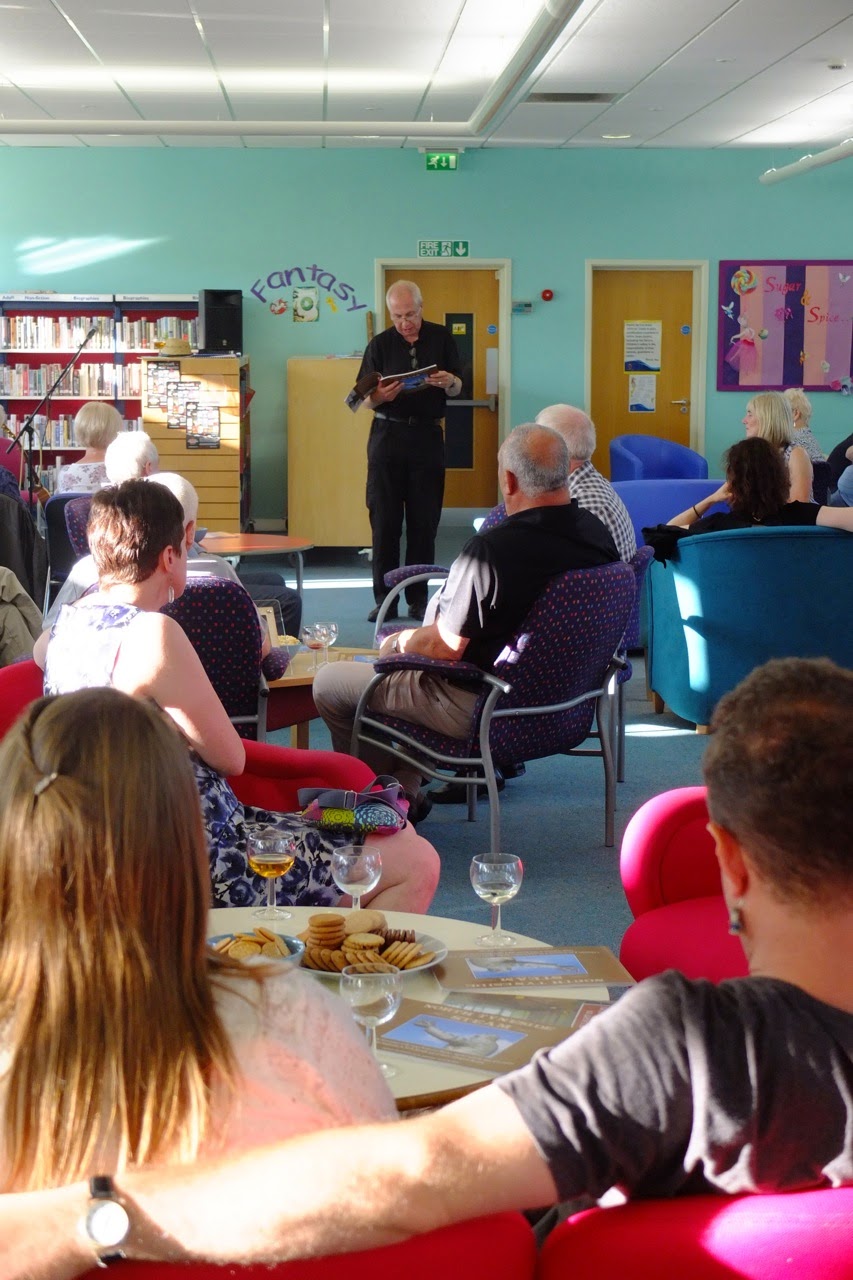
Book Launch

at Killingworth Library, White Swan Centre, Killingworth

6pm on Friday 25th July 2014.

Includes readings of poems and short stories from
the book and music from The Sawdust Jacks, Tony Morris and Gary Miller. Also featuring Ann Sessoms on Northumbrian Pipes. 

Light refreshments available.


NORTH TYNESIDE STEAM:
HERITAGE OPEN DAYS EVENT

This new book from Northern Voices Community Projects, commissioned by North Tyneside Council, with the support of the Heritage Lottery Fund, has been published to mark the bicentenary of George Stephenson's steam locomotive Blucher and tells the story of its creator in Killingworth and North Tyneside and of steam railways in the area.
Contributors to the book will perform their poems, stories and songs introduced by the editor local poet Keith Armstrong with Ann Sessoms on Northumbrian Pipes. 

WHITE SWAN CENTRE CAFE, KILLINGWORTH, FRIDAY 12TH SEPTEMBER AT 11AM.

Tuesday, 1 July 2014

THE POET WHO SUNG ON THE BANKS OF THE TYNE


Enter St John's Churchyard, near Newcastle Central railway station, and you will find towards the rear an inscribed monument which covers the grave of the pastoral poet John Cunningham (1729-1773).


St John's Churchyard was noted for its 'poets' corner'. Unfortunately, apart from John Cunningham their memorial stones are now missing. They include two contemporaries to Robert Gilchrist -  William Watson (1796 - 1840) whose many songs included 'Dance to the Daddy', and timber merchant and songwriter Thomas Thompson (1773-1816), who was a mentor to Robert. Gilchrist composed a sentimental eulogy to Thompson upon his death in 1816.

Gilchrist wrote a number of eulogies to Newcastle's poets and civic dignataries and a fine one to Cunningham was published in Robert's Poems of 1826. It reads: