Friday, 20 November 2020
Saturday, 14 November 2020
Marsden Rock
Sensational Rock,
swimming in light.
Bird cries clinging to ancient ledges,
Kittiwakes smashing against time.
What tales you could tell.
Your face is so moody,
flickers with breezes,
crumbles in a hot afternoon.
Climbing your powdery steps,
we look down on the sea
thrashing at you.
We join a choir of birds at your peak,
cry out to the sky
in good spirits.
Nesting for the sake of it,
our lyrics are remnants on the shore.
We keep chipping away,
do we not?
We slip
through the pebbles,
splashing
with babies.
We leave our mark,
a grain
on the ancient landscape.
We go.
We dance like the sunlight
on your scarred body:
tripping,
falling,
singing
away.
KEITH ARMSTRONG
As published in new book by Bill Greenwell:
Saturday, 24 October 2020
The Streets of Tyne
KEITH ARMSTRONG
Wednesday, 19 August 2020
Following the Advice of Scryence
Rune casting
In the
Ministry of Misdirection
Indicates
A decimal point
Out of place
Add
Ten to the tally
Knighthood
For the minister
Rename ministry
Ministry of Conceits
Orders
Entrails of ravens
Requisitioned from the Tower
Be examined
Calculations to date
Revealed
As misleading
Add
Hundreds to the tally
Elevate
Minister to the Lords
Rename ministry
Ministry of Ill-health
And
Social Carelessness
Tea leaves
Be consulted
Palms
Read on Sunday
Leaving
No doubt
Add
Thousands to the tally
Beatify
Secretary of State
Indicate
Truth must lie
With
Astrologers
Dave
Alton
Tuesday, 7 July 2020
Wednesday, 1 July 2020
MONUMENTS
They will build no more of
these winged tributes;
the feathered stones
of the Empire in flight
with God on our Tyne Side.
There will be
no more heroes like
Cowen and Armstrong
and Stephenson and Grey.
Their self made sculptures
have come
to a standstill.
Baked in dust and
bird shit,
they shelter from
a Life on the Dole.
KEITH ARMSTRONG
Sunday, 21 June 2020
Monday, 8 June 2020
GREY'S MONUMENT
Grey –
this man and his brain’s conception,
clasped in stone.
Disdainful figure
raised
on a firm, dry finger;
proud-stiff
above a time-bent avenue of dwindling lights.
The Earl’s pale forehead is cool and cloudy;
unblinking,
he views us all (as we view him)
in the same old, cold, way –
through the wrong end of a battered telescope,
through the dusty lens of history.
Strip away the tinsel
and this city’s heart is stone.
Keith Armstrong
AND SUCH GREAT MEN
Dobson and Grainger
were Giants of Men.
Men of Mark,
with huge hands,
they tore this town
in two.
Rebuilt it,
hauled in
rail lines,
puffed steam
into gleaming
engines.
Miracle workers
they were,
Walkers on Tyne.
So we gather in the tales
of our Great Historians.
But what of the true grafters,
the blistered and
the bruised?
What of the People
buried underground
beneath the library shelves?
What of the quiet men and women
who really built this town?
KEITH ARMSTRONG
Tuesday, 2 June 2020
Thursday, 21 May 2020
Friday, 15 May 2020
I WILL SING OF MY OWN NEWCASTLE

I WILL SING OF MY OWN NEWCASTLE
sing of my home city
sing of a true geordie heart
sing of a river swell in me
sing of a sea of the canny
sing of the newcastle day
sing of a history of poetry
sing of the pudding chare rain
sing of the puddles and clarts
sing of the bodies of sailors
sing of the golden sea
sing of our childrens’ laughter
sing of the boats in our eyes
sing of the bridges in sunshine
sing of the fish in the tyne
sing of the lost yards and the pits
sing of the high level railway
sing of the love in my face
sing of the garths and the castle
sing of the screaming lasses
sing of the sad on the side
sing of the battles’ remains
sing of the walls round our dreams
sing of the scribblers and dribblers
sing of the scratchers of livings
sing of the quayside night
sing of the kicks and the kisses
sing of the strays and the chancers
sing of the swiggers of ale
sing of the hammer of memory
sing of the welders’ revenge
sing of a battered townscape
sing of a song underground
sing of a powerless wasteland
sing of a buried bard
sing of the bones of tom spence
sing of the cocky bastards
sing of a black and white tide
sing of the ferry boat leaving
sing of cathedral bells crying
sing of the tyneside skies
sing of my mother and father
sing of my sister’s kindness
sing of the hope in my stride
sing of a people’s passion
sing of the strength of the wind
KEITH ARMSTRONG
(as featured on BBC Radio 4)
Friday, 8 May 2020
Saturday, 2 May 2020
THOMAS SPENCE 1750-1814 - 270TH BIRTHDAY
(In loving memory of Professor Malcolm Chase 1957-2020)
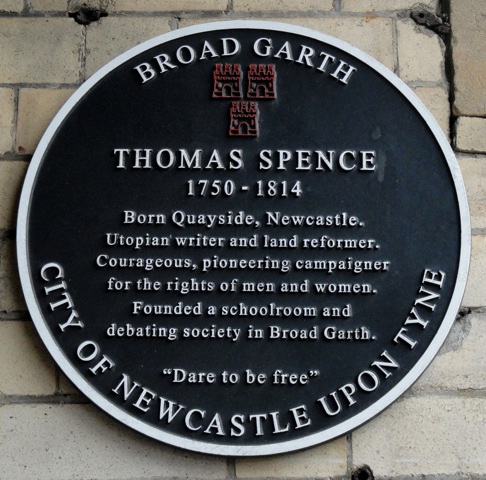
(Malcolm in the Red House, Newcastle, in 2010 celebrating the unveiling of the plaque in Spence's memory on Newcastle Quayside)
THOMAS SPENCE'S 270TH BIRTHDAY!
It's worth celebrating the birth in Newcastle upon Tyne on 21st June 1750 of radical fighter for human rights Thomas Spence.
Happy birthday Tom from everyone at The Thomas Spence Trust, responsible for the commemorative Spence plaque on the Quayside and an extensive series of events and publications dedicated to him over the years.
THE HIVE OF LIBERTY
(AFTER THE NAME OF THOMAS SPENCE’S BOOKSHOP AT 8 LITTLE TURNSTILE, HOLBORN)
I am a small and humble man,
my body frail and broken.
I strive to do the best I can.
I spend my life on tokens.
I traipse through Holborn all alone,
hawking crazy notions.
I am the lonely people’s friend.
I live on schemes and potions.
For, in my heart and in my mind,
ideas swarm right through me.
Yes, in this Hive of Liberty,
my words just flow ike wine,
my words just flow like wine.
I am a teeming worker bee.
My dignity is working.
My restless thoughts swell like the sea.
My fantasies I’m stoking.
There is a rebel inside me,
a sting about to strike.
I hawk my works around the street.
I put the world to rights.
For, in my heart and in my mind,
ideas swarm right through me.
Yes, in this Hive of Liberty,
my words just flow like wine,
my words just flow like wine.
KEITH ARMSTRONG
THE THOMAS SPENCE TRUST
35 Hillsden Road, Whitley Bay, Tyne & Wear NE25 9XF
Tel. 0191 2529531
It’s good to welcome the establishment of The Thomas Spence Trust, founded by a group of Tyneside activists intent on celebrating and promoting the life and work of that noted pioneer of people’s rights, pamphleteer and poet Thomas Spence (1750-1814), who has born on Newcastle’s Quayside in those turbulent times.
Spence served in his father’s netmaking trade from the age of ten but went on later to be a teacher at Haydon Bridge Free Grammar School and at St. Ann’s Church in Byker under the City Corporation. In 1775, he read his famous lecture on the right to property in land to the Newcastle Philosophical Society, who voted his expulsion at their next meeting.
He claimed to have invented the phrase ‘The Rights of Man’ and chalked it in the caves at Marsden Rocks in South Shields in honour of the working-class hero ‘Blaster Jack’ Bates, who lived there.
He even came to blows with famed Tyneside wood-engraver Thomas Bewick (to whom a memorial has been recently established on the streets of Newcastle) over a political issue, and was thrashed with cudgels for his trouble.
From 1792, having moved to London, he took part in radical agitations, particularly against the war with France. He was arrested several times for selling his own and other seditious books and was imprisoned for six months without trial in 1794, and sentenced to three years for his Restorer of Society to its Natural State in 1801.
Whilst politicians such as Edmund Burke saw the mass of people as the ‘Swinish Multitude’, Spence saw creative potential in everybody and broadcast his ideas in the periodical Pigs’ Meat.
He had a stall in London’s Chancery Lane, where he sold books and saloup, and later set up a small shop called The Hive of Liberty in Holborn.
He died in poverty ‘leaving nothing to his friends but an injunction to promote his Plan and the remembrance of his inflexible integrity’.
The Thomas Spence Trust organised a mini-festival to celebrate Spence in 2000 when it published a booklet on his life and work, together with related events, with the aid of Awards for All.
Trust founder-member, poet Keith Armstrong has written a play for Bruvvers Theatre Company on the socialist pioneer which has been performed at St. Ann’s Church and other venues in the city.
Now the Trust has successfully campaigned for a plaque on the Quayside in Newcastle, where Spence was born. The plaque was unveiled on Monday June 21st 2010, Spence's 260th birthday, with a number of talks, displays and events coinciding with it.
A book 'Thomas Spence: The Poor Man's Revolutionary', edited by Alastair Bonnett and Keith Armstrong, was published by Breviary Stuff Publications, with launch events, in 2014, the 200th anniversary of Spence's death.
Further information from: Dr Keith Armstrong, The Thomas Spence Trust, 35 Hillsden Road, Whitley Bay, Tyne & Wear NE25 9XF. Tel. 0191 2529531.
SPEECH BY DR KEITH ARMSTRONG AT UNVEILING OF SPENCE PLAQUE
On behalf of The Thomas Spence Trust and Newcastle City Council, I’m delighted to welcome you here today to unveil a plaque in honour of that great free spirit, utopian writer, land reformer and courageous pioneering campaigner for the rights of men and women, Thomas Spence. Myself and other members of our Trust, especially Peter Dixon and Tony Whittle, with the support of people like Professors Joan Beal, Alastair Bonnett and Malcolm Chase and activists like Michael Mould, Alan Myers and Councillor Nigel Todd, have campaigned for well over 10 years for some kind of memorial to Tom Spence and it is with great pride that we assemble here with you today.
We know that Spence was born on the Quayside on June 21st 1750, 260 years ago to this the longest day and Summer Solstice. We know that his father Jeremiah made fishing nets and sold hardware from a booth on Sandhill and his mother Margaret kept a stocking stall, also on Sandhill, but it has not been possible, all these years on, to pinpoint the exact location of Thomas Spence’s birthplace, which is why this plaque has been installed here at Broad Garth, the site of his school room and debating society and where he actually came to blows with Thomas Bewick because of a dispute over the contentious matter of property. Bewick gave Spence a beating with cudgels on that occasion but, surprisingly enough, they remained lifelong friends. As Bewick said of Spence: ‘He was one of the warmest Philanthropists in the world and the happiness of Mankind seemed, with him, to absorb every other consideration.’
In these days of bland career politicians, Spence stands out as an example of a free spirit, prepared to go to prison for his principles - the principles of grass roots freedom, community and democracy, for the human rights of people all over the world.
FOLK SONG FOR THOMAS SPENCE
Down by the old Quayside,
I heard a young man cry,
among the nets and ships he made his way.
As the keelboats buzzed along,
he sang a seagull’s song;
he cried out for the Rights of you and me.
Oh lads, that man was Thomas Spence,
he gave up all his life
just to be free.
Up and down the cobbled Side,
struggling on through the Broad Chare,
he shouted out his wares
for you and me.
Oh lads, you should have seen him gan,
he was a man the likes you rarely see.
With a pamphlet in his hand,
and a poem at his command,
he haunts the Quayside still
and his words sing.
His folks they both were Scots,
sold socks and fishing nets,
through the Fog on the Tyne they plied their trade.
In this theatre of life,
the crying and the strife,
they tried to be decent and be strong.
Oh lads, that man was Thomas Spence,
he gave up all his life
just to be free.
Up and down the cobbled Side,
struggling on through the Broad Chare,
he shouted out his wares
for you and me.
Oh lads, you should have seen him gan,
he was a man the likes you rarely see.
With a pamphlet in his hand,
and a poem at his command,
he haunts the Quayside still
and his words sing.
KEITH ARMSTRONG
(from the music-theatre piece ‘Pig’s Meat’ written for Bruvvers Theatre Company)
SPENCE IN LONDON:
https://www.youtube.com/watch?v=3IMy-h2re3g
Wednesday, 29 April 2020
Sunday, 12 April 2020
THE SUN ON DANBY GARDENS
The sun on Danby Gardens
smells of roast beef,
tastes of my youth.
The flying cinders of a steam train
spark in my dreams.
Across the old field,
a miner breaks his back
and lovers roll in the ditches,
off beaten tracks.
Off Bigges Main,
my grandad taps his stick,
reaches for the braille of long-dead strikes.
The nights
fair draw in
and I recall Joyce Esthella Antoinette Giles
and her legs that reached for miles,
tripping over the stiles
in red high heels.
It was her and blonde Annie Walker
who took me in the stacks
and taught me how to read
the signs
that led inside their thighs.
Those Ravenswood girls
would dance into your life
and dance though all the snow drops
of those freezing winters,
in the playground of young scars.
And I remember freckled Pete
who taught me Jazz,
who pointed me to Charlie Parker
and the edgy bitterness of Brown Ale.
Mrs Todd next door
was forever sweeping
leaves along the garden path
her fallen husband loved to tread.
Such days:
the smoke of A4 Pacifics in the aftermath of war,
the trail of local history on the birthmarked street.
And I have loved you all my life
and will no doubt die in Danby Gardens
where all my poems were born,
just after midnight.
KEITH ARMSTRONG
Michael Callaghan: Absolutely brilliant Keith!
Conrad Atkinson: Another gem Keith Best Conrad
Thursday, 2 April 2020
GORDON PHILLIPS - TYNESIDE POET (1949 - 2017): IN MEMORIAM
Dave Alton
POEM FOR GORDON (1949-2017)
Across a Fenham avenue,
through the pools of stars in your eyes,
the seering light of your vision,
I saw your finely hewed words running towards me,
a crystal stream
tearing along these Newcastle lanes.
We tripped along together
in huddled poetry readings,
throbbing public houses
and ancient mansions,
searching for images
to make our days
brighter,
longing for a folk song
to drink with
in the approaching darkness.
Searching,
always searching,
for the right words
to sing to our loved ones,
we crossed the sea
to fulfil our dreams
from the flat land of East Anglia
into the arms of Scandinavia,
returning with that smile of yours
still intact,
beaming with the sun
breaking up the clouds
on any dogged northern day
in your adopted home,
lending a sparkle to Grainger Street,
a twinkle to our beer;
the joy of a lasting friend,
the spilt dreams
forever flowing with us.
KEITH ARMSTRONG
THE TREATMENT BELL (GORDON'S FINAL POEM)
On the side wall, beside the reception
hangs the treatment bell,
pristine, silver,
its shine an encouraging glow.
Before it, hopeful patients sit.
The next ringer strikes a note for them all:
a customary three times
for an end of plan toll,
excitement measured in the hammering and applause.
Gordon Phillips, 18th December 2016
Note from Maureen Phillips:
The first time Gordon and I heard the three rings of the bell was on his first visit to the Department of Radiation Oncology for consultative purposes to evaluate and determine his most optional treatment.
The inscription on the bell is:
Ring this bell
Three times well
It's toll to clearly say
My treatment's done
This course is run
And I am on my way
FOR THOMAS BEWICK
In your precious art you raised
delicate species fresh, alive
with every searching niche of blade,
on metalled tints of bone
in flesh, conceived.
Today, our clear eye can review
that aggregate of animals
and speading plants which grew;
now your thoughts to Cherryburn
are our adoption.
Through sludge of field flung back
from my drag of parting feet,
crossing rutted rural lands
you swept in light and shade,
a lock of trees
inside a border to engrave.
Gordon Phillips
(as read by Dave Alton at Gordon's funeral on Thursday 16th February 2017 at St Robert of Newminster Roman Catholic Church, Newcastle upon Tyne)
Thursday, 19 March 2020
NEW FROM DAVE ALTON
Sunday, 8 March 2020
HOTEL UTOPIA
(for Tony Whittle)
Tuesday, 25 February 2020
PARK LIFE
CELEBRATING GREEN SPACES IN NORTH TYNESIDE
Local people are invited to send written contributions to our new anthology Park Life - celebrating green spaces in North Tyneside. Poetry, prose and lyrics all inspired by local parks (see information below) and a green agenda generally are welcome to reach us by the end of April 2020. Contibutors may email several written pieces to us as our aim is to ensure that all parks in North Tyneside are celebrated in the writing.
The anthology, published jointly by North Tyneside Council and Northern Voices Community Projects, will be launched in September as part of this year's Heritage Open Days events.
We look forward to hearing from you soon.
Best wishes,
Doctor Keith Armstrong,
Northern Voices Community Projects,
35 Hillsden Road,
Whitley Bay,
Tyne & Wear NE25 9XF.
Tel 2529531
k.armstrong643@btinternet.com
Northumberland Park
Nestled between Tynemouth and North Shields, Northumberland Park has attracted visitors to its woodland paths, gardens, lake and bowling green since it was opened in 1885.
Northumberland Park offers a tranquil green space with a variety of landscapes, providing a mixture of Victorian elegance and urban wilderness.
Resting on the medieval site of St Leonard’s hospital and chapel – which has been explored using archaeological digs – today it hosts scenic walks, a herb garden, tea room, bandstand, sculpture trail, children’s play area and BMX pump track.
Marden Quarry - Whitley Bay
10 minutes walk from Whitley Bay town centre is Marden Quarry Park – with mature woodland and limestone grassland. It offers an unusual landscape, as virtually the only exposure of magnesium limestone north of the River Tyne.
It is a local nature reserve too, with a large wildfowl lake supporting breeding birds such as the mute swan, mallard, moorhen, coot, tufted duck and seasonal migrating birds.
The quarry park celebrated its 40th anniversary in November 2017.
Richardson Dees – Wallsend
Wallsend Parks are a group of three public parks, close to Wallsend town centre.
They form a resource for wildlife and people in three unique, connected green spaces over 16 hectares in size.
The grounds are adjacent to the Green which was the site of the original Wallsend village in medieval times. In the 19c two large houses stood to the north of the Green; Wallsend Hall and The Red House which both had substantial ornamental gardens now incorporated into the park.
To the south east of the site was the 'C' Pit, an extension of Wallsend Colliery, which was closed in 1854.
Wallsend Parks is made up of:
Wallsend Civic Hall Grounds – a quiet parkland with formal walks and points of historical interest, dating back as far as 1790
Prince Road Arboretum – an open grassland area, sloping down to a natural burn with a mixture of open spaces and beautiful views
Richardson Dees Park – a Victorian park dating from 1900, incorporating formal planting with a wide range of facilities:
multi-age play area
Verandah Café
bandstand
community pavilion
bowling greens
outdoor gym
tennis and basketball courts
skate park
multi-use games area
lakeside and woodland walks
sculpture story trail
Rising Sun Countryside Park
The Rising Sun Country Park is now a site in Benton that once housed one of the world’s largest coal mines. It has been transformed into a 400 acre natural green oasis. The Park is a site of Nature Conservation Interest (SNCI) and the lake is designated as a Local Nature Reserve (LNR).
The Rising Sun Country Park is a green oasis of 162 hectares, set in the heart of North Tyneside.
Boasting a nature reserve with ponds, woodlands and extensive grasslands; a farm and Countryside Centre, the site is a haven for wildlife and an ideal place to relax and enjoy the great outdoors.
Benton Quarry
A quarry of some sort has been here since Roman times and it is said that when the quarry came into full production in the 1800s – the age of the industrial revolution – the sandstone was used to help build some of Newcastle’s famous buildings.
The unfenced quarry became worked out and filled up with water in the 1930s, with the exception of an island known by locals as ‘Froggy Island’ – suggesting it was a haven for frogs.
In the 1960s, the council of the time used the quarry for disposal of building rubble and the quarry basin was filled in. Lime, sycamore and horse chestnut trees surrounded the quarry and it was fenced off. The land inside was basically grassy scrubland and a local farmer used it to feed his goats.
Then in the late 1970s and 1980s trees were planted with the help of local volunteers and Scout groups. The park was left to develop naturally and little more was done until 2003 when North Tyneside Council reintroduced Park Wardens. The old pathways were then reclaimed and the park started to look as it is now.
Silverlink Biodiversity Park
Silverlink Park LNR incorporates Silverlink Biodiversity Park and West Allotment Pond, and occupies approximately 18 hectares in the centre of Cobalt Business Park, just off the A19.
As part of a new development scheme in 1996, a new country park was created on the site of a former rubbish tip.
This 'Biodiversity Park' together with the pond at West Allotment was declared a Local Nature Reserve in 2005.
The reserve holds significant biodiversity value, with woodland, scrub and hedgerow, grassland and tall herb, wetland and exposed rock habitats.
In particular, the site is of note for its amphibian and invertebrate population. The ponds and ditches are teeming with invertebrates such as pond skaters, blue-tailed damselfly and whirligig beetles.
Roe deer, fox, brown hare and rabbit can all be discovered in the park's grassland, whilst kestrels are regularly seen hovering overhead.
The grassland is also home to many species of butterfly such as meadow brown, common blue and small white.
A giant sundial sits on top of the central hill, and for this reason the site is sometimes referred to as the 'Sundial Park'.
Free parking is available on site, directly opposite the Village Hotel on The Silverlink North.
Killingworth Lakeside
Killingworth Lake is a popular man-made lakeside park. The highlight is a small colony of Mute Swans which attracts a great deal of interest. At times Whooper and on rare occasions Bewick Swans can also come to visit. There are two lakes, either side of a main road. There is a patch of open grassland on the southern shore and there are patches of woodland along the edges of the park which are home to singing Warblers such as Blackcap, Chiffchaff and Willow Warbler in the spring/summer months.
Close to the road which separates the two lakes, Cormorants and Grey Herons can be seen on some wooden platforms. The site remains a good site for Common Terns and Great Crested Grebes in the summer.
On occasion Black Terns have also been recorded visiting this site.
Royal Quays/ Chirton Dene/ Parks, North Shields
A recently developed park, part of the Royal Quays regeneration. The name comes from the Chirton Burn, previously a culverted burn which ran into the Tyne, but has been restored and integrated into a series of water features. A lake attracts swans, gulls, ducks and wildfowl. To the north it connects with the Parks Centre which was originally a recreation area for Smiths Docks Company workers. To the south it meets the Royal Quays Marina, formerly the Albert Edward Dock.
Weetslade Countryside Park
This is reclaimed from the site of the old Weetslade Colliery which closed in 1966 and can found up near Dudley.
The sinking of Weetslade Colliery began on the 6th of August 1900 and the colliery opened in c.1903. Weetslade had workings connected with the nearby Burradon Colliery, though the two mines had separate ventilation systems. The colliery was on a branch of the Seaton Burn Wagonway. In the 1910s Weetslade Colliery was owned by the Burradon & Coxlodge Coal Co. Ltd., and then in the 1940s by the Hazlerigg & Burradon Coal Co. In 1947 Weetslade Colliery was recorded as producing 160,000 tons of coal for household, manufacturing and steam production. By 1960 there were 638 people employed at the colliery (488 working below ground and 150 working on the surface). Weetslade Colliery closed on the 10th of September 1966. The site continued to be used as a washery until 1980 before being left abandoned. Many years later the site was landscaped to become Weetslade Colliery Country Park, which opened in 2006


